Week 10 — Elements 4–5
Evaluate game prototype
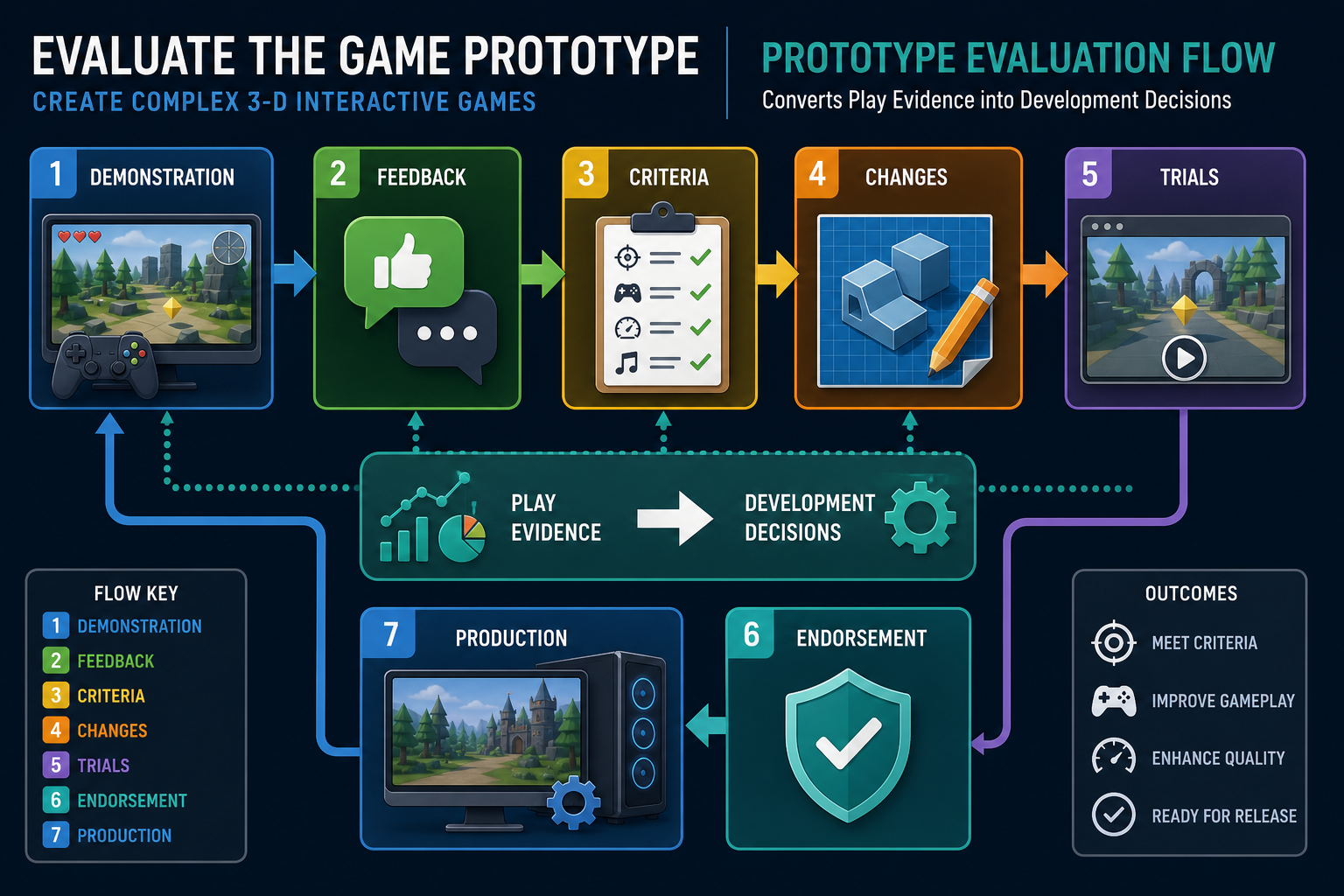
Why this element matters
A complex 3-D interactive game is not ready for full production just because a prototype runs in the engine. The prototype must be demonstrated, tested, evaluated and formally endorsed before the team commits major time and budget to complete assets, code, levels, user interface, audio, optimisation and release preparation.
In industry, a prototype is a focused working version of the game used to test whether the core concept works. It may include greybox levels, placeholder art, temporary sounds, rough user interface, limited enemy behaviour, or only one complete gameplay loop. Its value is that it makes the idea tangible. Designers, programmers, artists, producers, clients and testers can play it, challenge assumptions and provide feedback before expensive work is locked in.
What you will learn
In this element you will learn how to:
- Demonstrate an initial prototype to the right people and actively seek useful feedback.
- Evaluate the prototype against agreed criteria, including creativity and user-friendliness.
- Discuss feedback, negotiate priorities and agree on required changes.
- Assist with structured tests and user trials.
- Analyse feedback from trials and convert it into practical development decisions.
- Confirm endorsement and use that endorsement to move from prototype to complete product.
This is not just a quality assurance activity. It combines production planning, human-centred design, technical evaluation, risk management and communication. At Diploma level you are expected to make reasoned judgements in non-routine situations, not simply collect comments. For example, if players love a mechanic but it causes severe frame-rate drops on target hardware, you need to understand the trade-off and help the team decide whether to optimise, simplify, redesign or defer that feature.
How this connects to the unit
Earlier work in this unit focuses on planning and building the prototype. This element closes the loop. You use evidence from required personnel and user trials to decide whether the prototype should be changed, expanded or rejected. You will also apply underpinning knowledge of game engines, programming, asset integration, hardware constraints, testing schedules, critical path management and production terminology.
Australian workplace practice also matters. You must handle participant information responsibly, respect copyright and licence conditions for assets and software, manage WHS risks associated with long computer-based sessions, and communicate in a professional way. The outcome is a defensible decision: the prototype is endorsed for full development only when the required personnel agree that it is technically feasible, creatively worthwhile and usable for the intended players.