Week 4 — Element 2
Evaluate capability of game-engine software and tools
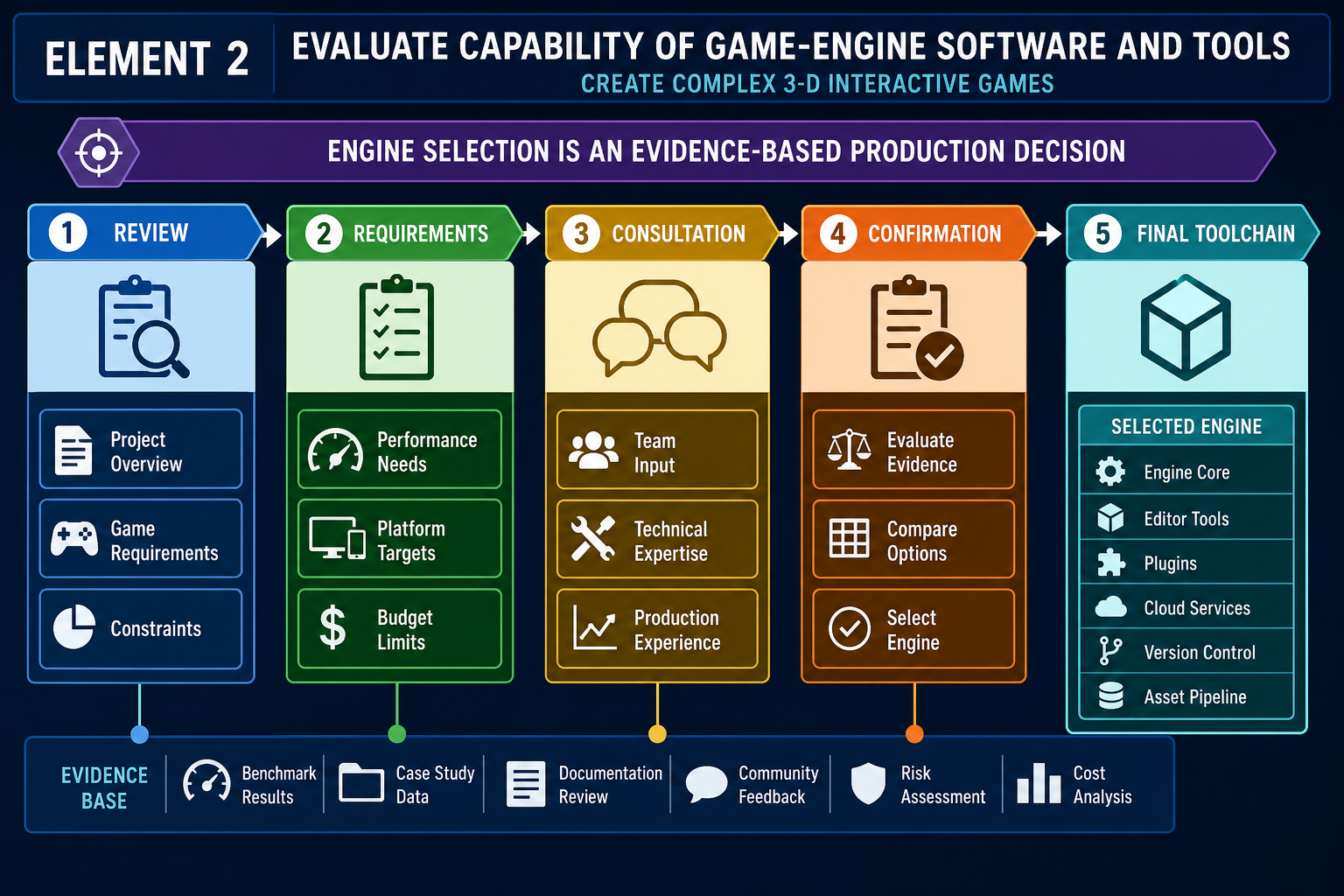
Why this element matters
A complex 3-D interactive game is shaped by its engine and toolchain from the first prototype. The engine affects rendering quality, physics behaviour, asset pipeline, scripting language, build size, target platforms, team workflow, licensing, testing effort and long-term maintainability. A poor choice can force rework, reduce visual quality, limit gameplay features or make the game impossible to run on the intended hardware.
In industry, engine selection is not a personal preference exercise. It is a production decision. A designer may prefer rapid prototyping, a programmer may want low-level control, an artist may need reliable import of skeletal meshes and materials, and a producer may focus on budget, licensing and schedule risk. At Diploma level, you are expected to analyse these trade-offs and recommend a toolset that supports specified outcomes.
In this element you will learn how to:
- identify and review current industry-standard game engines and development tools
- assess engines against a specific game concept and play requirements
- discuss selection considerations with required personnel and confirm the choice will meet outcomes
- select and justify game-engine software and development tools.
This connects directly to the rest of ICTGAM533. Before you can design, build, optimise and test a complex 3-D game, you need a game-engine environment that can support the creative, production and technical requirements. Your evaluation must also account for hardware constraints, asset integration issues, workplace consultation, legal obligations and safe work practices for computer-based development.