Week 13 — Element 5
5.6 Confirm endorsement from required personnel and develop prototype into a complete product
5.6 Understand endorsement
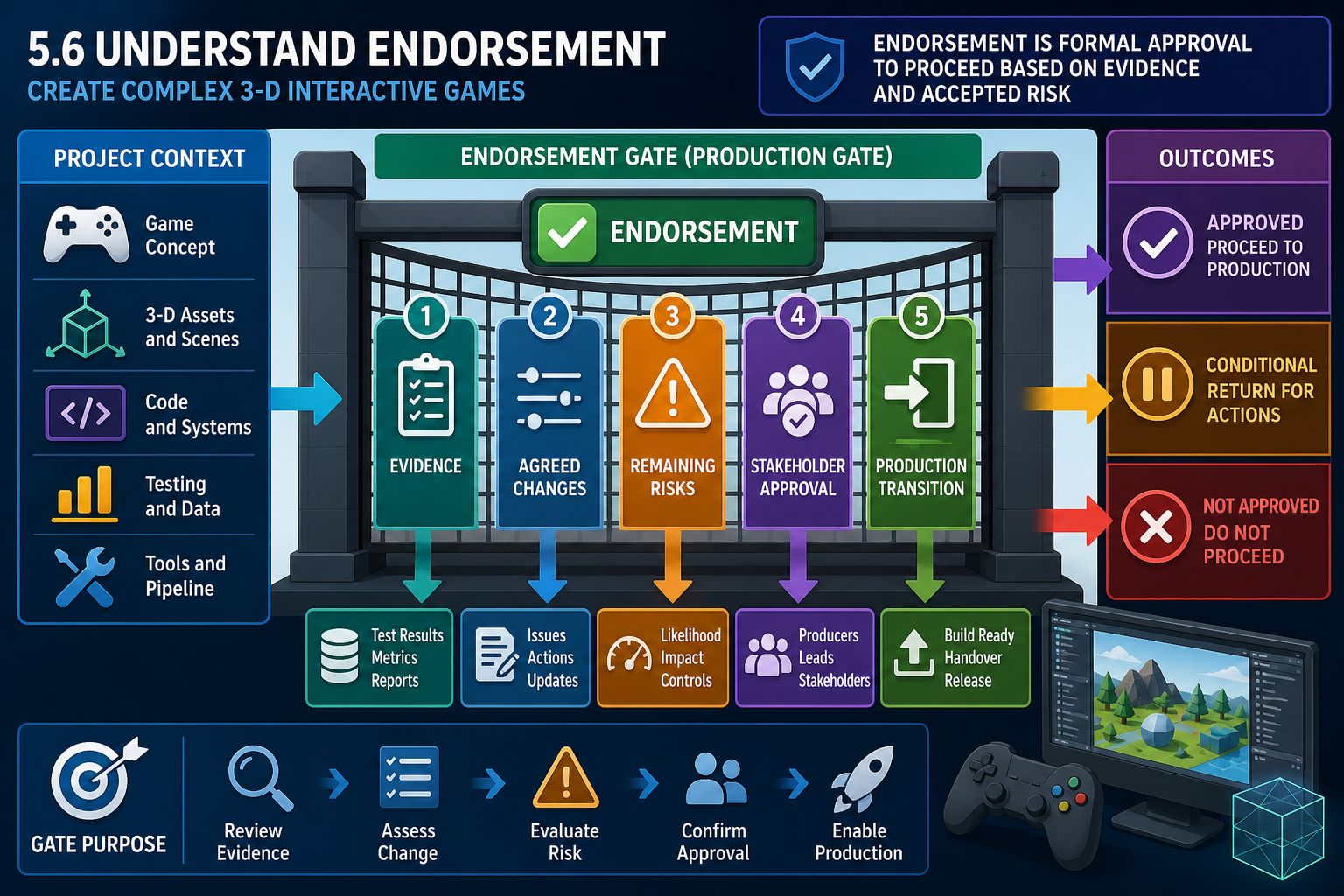
What endorsement means
The final criterion requires you to confirm endorsement from required personnel and develop the prototype into a complete product. Endorsement is formal or documented approval that the prototype has met enough criteria to proceed. It may come from a creative director, producer, client, publisher, product owner, trainer, assessment supervisor or other required personnel named in the project process.
Endorsement is not the same as everyone saying they like the game. It means the required personnel accept the evaluation evidence, agreed changes, remaining risks and development plan. They are authorising the team to move from prototype uncertainty into fuller production work.
Forms of endorsement
Depending on the workplace, endorsement may be recorded as:
- A signed milestone approval.
- Email confirmation from authorised stakeholders.
- Approval in a project management system.
- Meeting minutes with action decisions.
- Client acceptance of a prototype milestone.
- Trainer or assessor approval in an LMS.
- Producer sign-off to enter vertical slice, alpha or production.
For an online learning project, keep endorsement in a retrievable location. A chat reaction alone is usually weak evidence unless the project process accepts it and it clearly identifies who approved what.
Conditional endorsement
Endorsement may be conditional. For example: 'Approved to proceed to full production provided the team resolves the camera collision issue before content expansion and completes a performance test on target laptops.' Conditional approval is common because prototypes rarely solve every issue. Record conditions as tasks with owners and dates.
What required personnel check
Before endorsing, stakeholders may check:
- The prototype meets creative and user-friendly criteria sufficiently.
- Major user trial feedback has been evaluated and addressed or scheduled.
- Technical feasibility is credible for the target hardware and engine.
- Production scope is realistic.
- Asset pipeline and integration risks are understood.
- Legal and licence issues are not blocking production.
- WHS, privacy and participant data obligations from testing have been handled.
- The next development stage has a plan, schedule and risk register.
Example
A Fremantle indie team presents a 3-D ocean survival prototype to a funding partner. The partner endorses progression to a vertical slice after reviewing playtest findings, a revised scope, proof that the water shader can run on target consoles, and a plan to replace temporary sound effects with licensed or original audio. Endorsement is recorded in meeting minutes and the milestone payment is released according to the contract.
Common mistakes
Do not assume endorsement because no one objected. Silence is not approval. Also do not proceed to full production while major required personnel are absent unless the project governance permits it. Confirm who has authority and record the approval.
5.6 Plan the transition to complete product
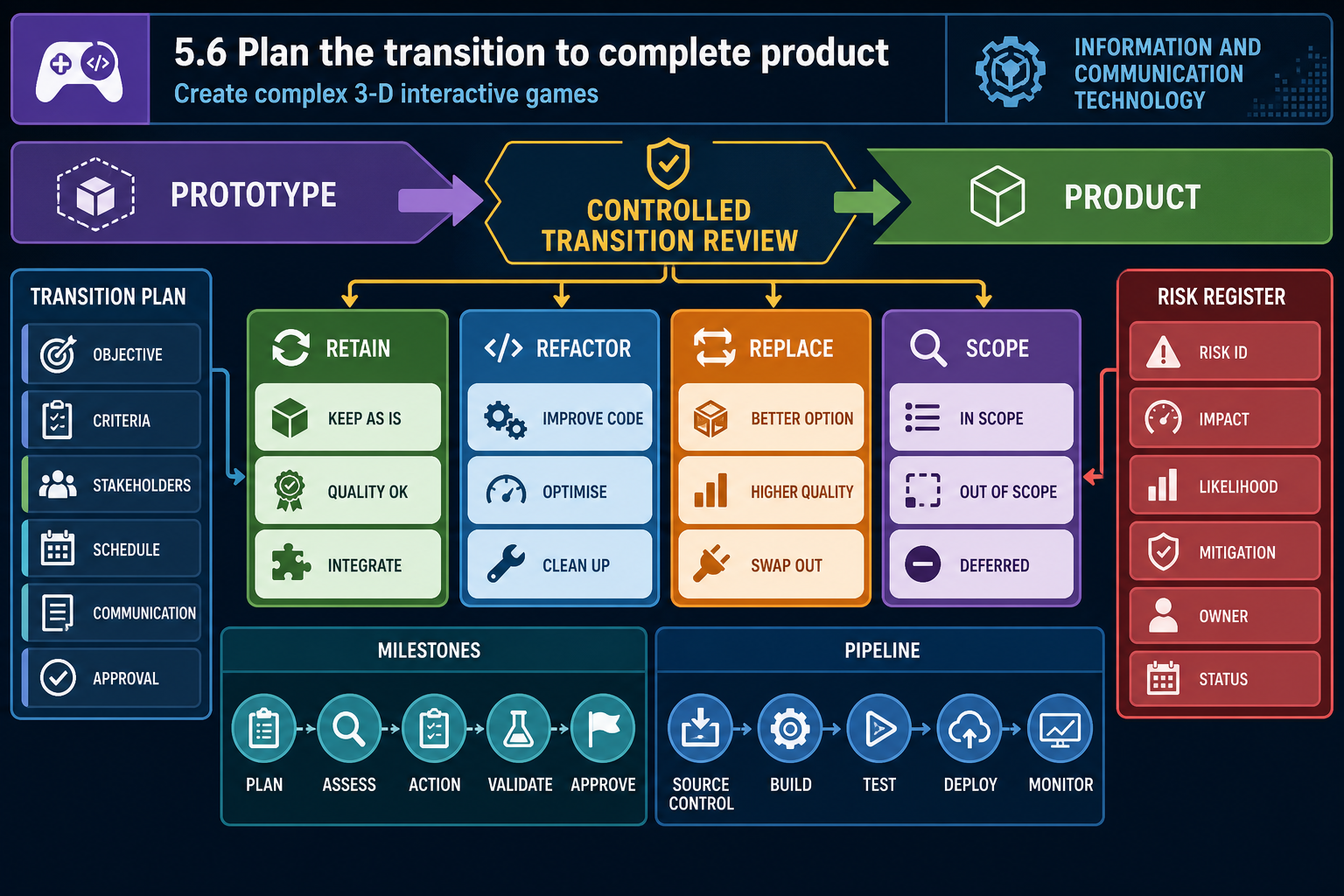
From prototype to production
Once endorsement is confirmed, the team develops the prototype into a complete product. This does not mean simply adding more levels to the prototype project. Prototypes are often built quickly to test ideas. They may contain temporary code, placeholder assets, rough UI, duplicated scripts, unoptimised materials, hard-coded values and incomplete data structures. Moving to a complete product requires planning.
Start with a transition review:
- Identify which prototype systems can be retained.
- Identify which systems must be refactored, replaced or rebuilt.
- Confirm the final creative direction and core gameplay loop.
- Define production scope: levels, characters, mechanics, UI, audio, platforms and content volume.
- Update technical requirements for target hardware and software.
- Confirm asset pipeline, naming, formats, version control and integration process.
- Build a production schedule with milestones and testing windows.
- Update risk register and critical path.
Technical debt
Technical debt is the future cost created when quick solutions are used instead of robust ones. Prototype technical debt is normal, but it must be managed. For example, a gameplay programmer may have used hard-coded enemy values to test combat quickly. In production, those values should move into data assets, configuration files or editable components so designers can balance the game without changing code.
Basic programming techniques matter here: modular code, readable naming, separation of concerns, version control, comments where useful, data-driven design and error handling. Visual scripting should also be structured and documented. Messy prototype logic can slow production and increase bugs.
Protect the creative core
The endorsed prototype usually contains a creative core: the mechanic or experience that justified development. Production planning should protect that core while improving usability, reliability and content depth. Avoid expanding features so much that the original strength is diluted. If user trials showed that a simple grappling mechanic was the main delight, do not bury it under complex inventory systems unless the criteria support that direction.
Example
A Launceston team receives endorsement for a 3-D time-loop puzzle prototype. The time rewind mechanic works and players love it. Before full development, the team rebuilds the prototype scripts into a reusable event system, standardises puzzle asset prefabs, creates a level design template, and schedules performance tests. This avoids copying fragile prototype logic into every level.
Common mistakes
Do not keep all prototype shortcuts because they seem to work. Also avoid throwing everything away without analysis. Some prototype work may be valuable. The skill is deciding what to carry forward, what to clean up and what to replace before production scales.
5.6 Build the production roadmap
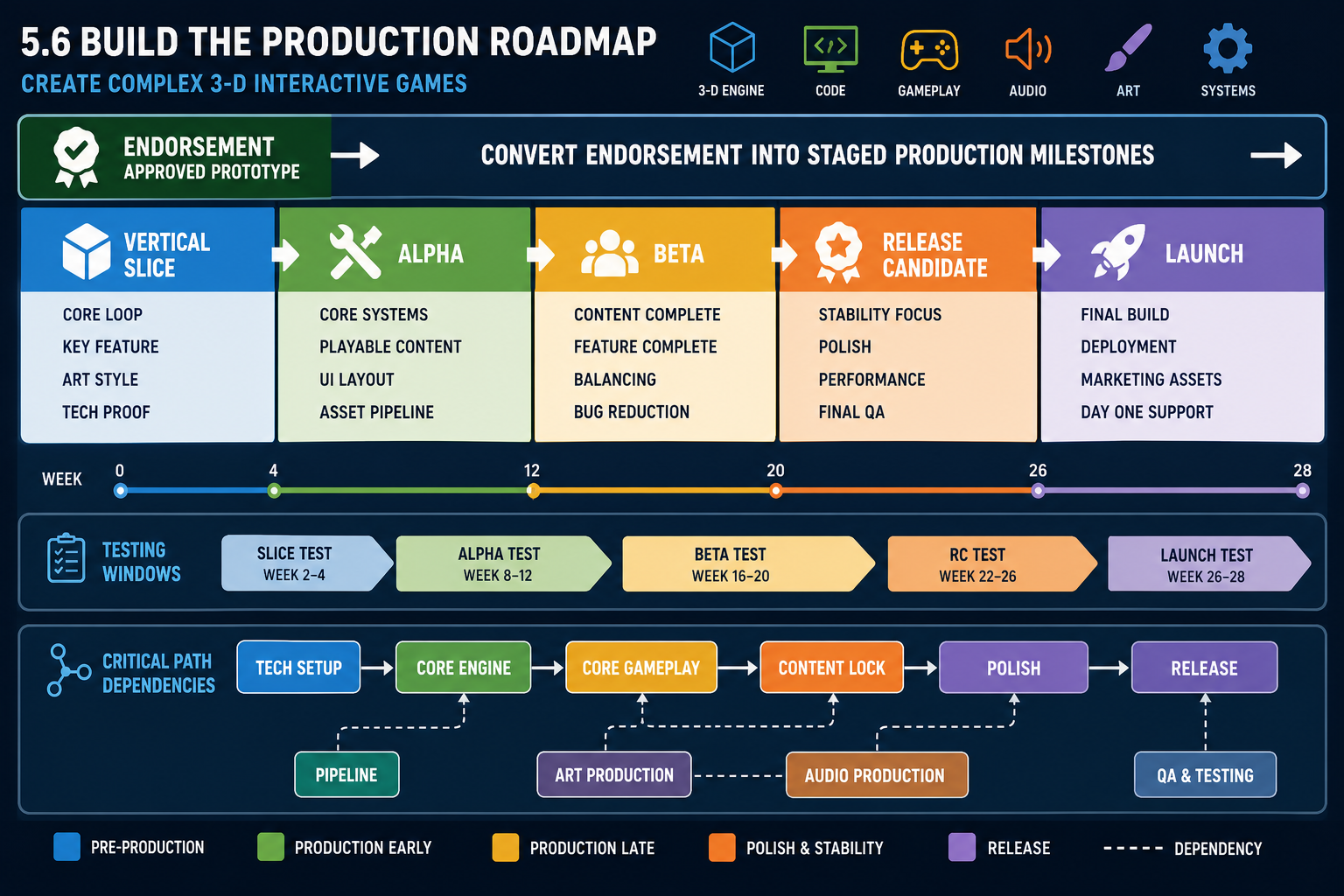
Roadmap after endorsement
Developing the prototype into a complete product requires a roadmap. A roadmap translates endorsement into staged work. It should show what will be built, when it will be tested, which dependencies must be resolved and how the team will know each stage is ready.
Common game development milestones include:
- Vertical slice: a small section built to near-final quality to prove the full production approach.
- Alpha: major features and content are implemented, though not polished.
- Beta: content is largely complete and focus shifts to bug fixing, optimisation and balancing.
- Release candidate: build is considered ready unless serious issues are found.
Not every project uses these exact terms, but the development process should still include staged gates and testing. For a student project, milestones may be prototype endorsement, production plan, first complete level, content complete, test build and final submission.
Schedule testing from the start
Testing is not something added at the end. Include functional testing, user trials, performance testing, compatibility checks and regression testing in the schedule. If you add a new enemy system, schedule tests for AI behaviour, animation integration, difficulty, performance and player readability. If you add new assets, schedule import and optimisation checks.
Use critical path management. Identify tasks that block many others. Examples include player controller finalisation, save system, network architecture, character rig, level streaming, UI framework and target platform build pipeline. Delays in these tasks can delay the entire product. Address high-risk critical path items early.
Hardware and software requirements
A complete 3-D game must be planned for target hardware and software products. Consider input devices, screen sizes, GPU capability, CPU load, memory, storage, operating systems, platform storefront requirements and engine version support. Technical constraints affect creative decisions. For example, a mobile 3-D game may need simpler shaders, shorter sessions and touch-friendly UI. A PC game can assume different input precision and display space, but still needs scalable settings.
Documentation outputs
After endorsement, produce or update:
- Game design document or living design wiki.
- Technical design notes.
- Art and asset pipeline guide.
- Production schedule or sprint plan.
- Test plan and quality criteria.
- Risk register and issue backlog.
- Version control and build process notes.
Example
A Cairns team developing a 3-D reef exploration game uses the endorsed prototype to plan a vertical slice. The roadmap prioritises swimming controls, reef asset pipeline, low-end laptop performance and educational objective UI before adding more species. This aligns creative, technical and production requirements.
Common mistakes
Avoid planning only content creation while ignoring tools, testing and optimisation. Also avoid changing engine versions mid-production without a strong reason and rollback plan. Engine upgrades can fix issues but may break assets, plugins or scripts.