Week 1 — Elements 1–4
4.3 Complete workplace form
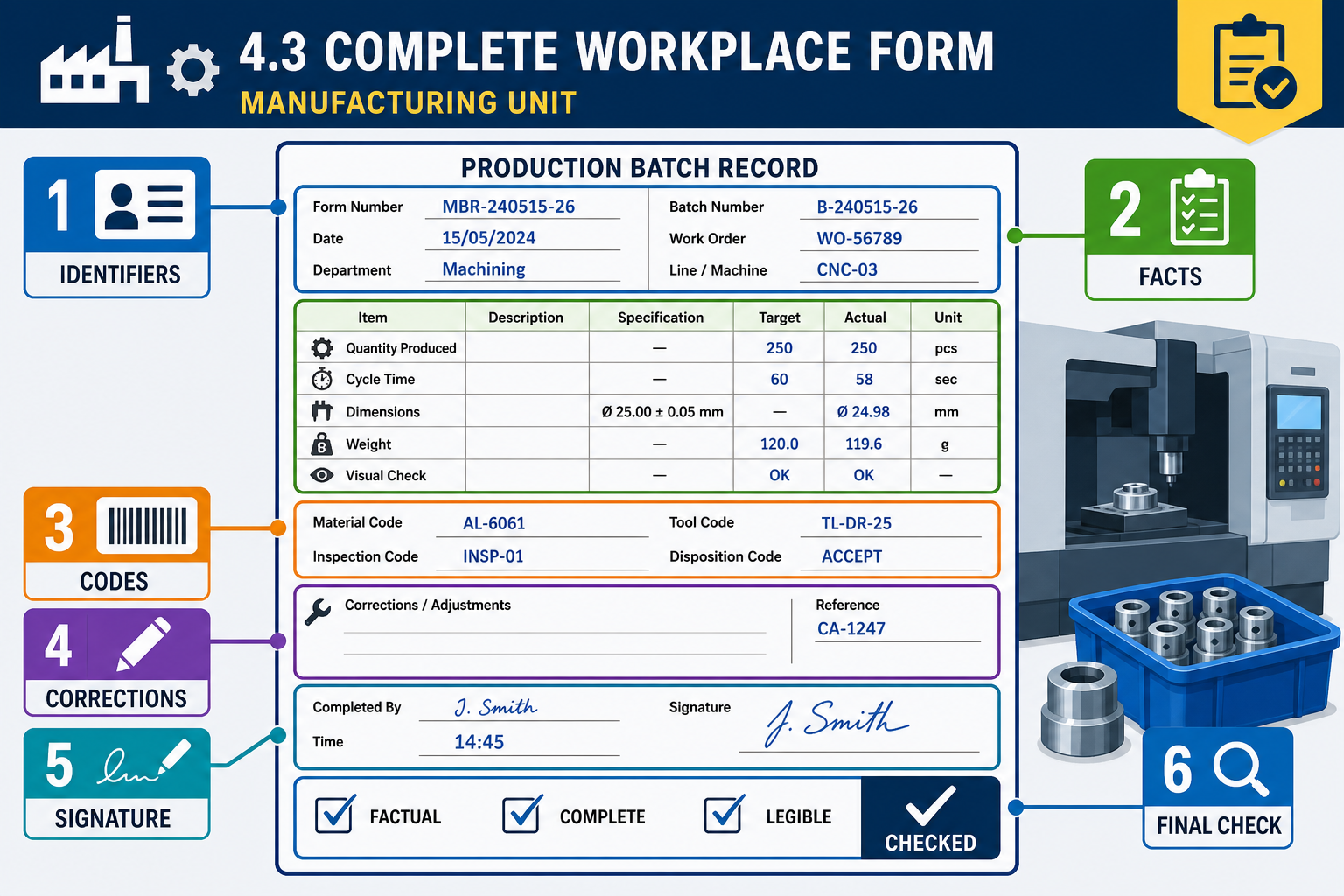
Completing the form correctly
Completing a workplace form means entering information so another person can understand it, act on it and rely on it later. Use clear writing, correct spelling where practical, standard workplace terms, approved abbreviations and the required units of measurement. If the form is electronic, choose the correct fields and drop-down options. If it is paper-based, write legibly in the required pen colour if the site specifies one.
Work through the form in a controlled way:
- Enter identifying details first: date, time, area, equipment number, job number, batch number or shift.
- Complete each required section using facts, not assumptions.
- Use the workplace codes, numbers, symbols and colours exactly as defined by the site. For example, “TK-204” may identify a tank, “PPE” may mean personal protective equipment, and a red tag may identify equipment that must not be operated.
- Use acceptable workplace language and tone. Be factual, courteous and respectful. Do not swear, blame people, mock accents or cultures, or write emotional comments.
- Sign, initial or enter your user ID only for work you completed or checked.
- Review the form before submission.
A strong incident description is specific: “At 0915, operator found 2 L of product on floor beside filler 3. Area barricaded and supervisor notified.” A weak description is: “Big mess because someone was careless.” The first version supports action and investigation; the second is unclear and disrespectful.
When communicating with workers from culturally and linguistically diverse backgrounds, keep wording plain and avoid slang such as “she’ll be right” or “dodgy thing near the gizmo”. If you need information from someone, speak calmly, use equipment names or numbers, point to the relevant field, and confirm understanding. If there is a safety risk or a complex matter, escalate to a supervisor and use interpreter or bilingual support if the workplace provides it.
If you make an error, follow the organisation’s correction procedure. On many paper records, this means a single line through the error, the correction, your initials and the date; however, your site may have specific rules, especially for quality or regulated records. Do not use correction fluid unless allowed. In electronic systems, do not share passwords or ask someone else to submit under your name. Accurate forms support WHS, quality, production and legal accountability.