Week 1 — Elements 1–4
3.2 Access information from appropriate sources
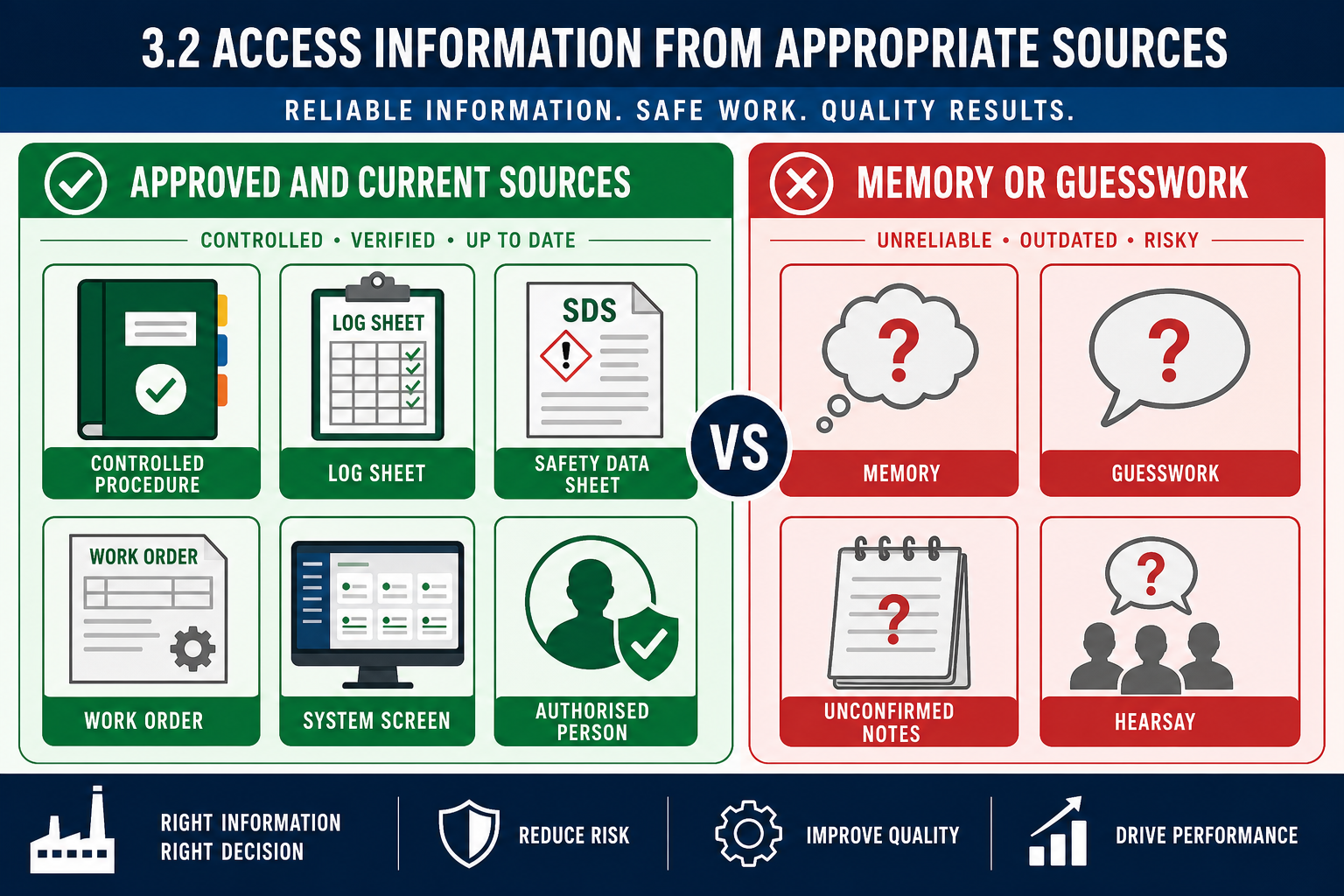
What makes a source appropriate?
An appropriate source is one your workplace accepts as reliable for that type of information. In a processing plant this may include standard operating procedures (SOPs), batch records, log sheets, control room screens, maintenance work orders, isolation registers, safety data sheets (SDS), production schedules, quality check sheets, permit systems, labels, signs, emails, shift handover notes, or an authorised supervisor, operator, quality officer or maintenance tradesperson.
Use the source that matches the request. For example, a chemical handling question should be checked against the SDS and workplace procedure, not a guess from memory. A production quantity should come from the approved log, system or confirmed count, not from “what usually happens”.
Step-by-step approach
- Identify the information required from the clarified request.
- Decide which source is approved for that information.
- Check that the document, screen or record is current and relates to the correct date, line, batch, product or equipment.
- Read the information carefully, including codes, numbers, symbols, colours and units of measure.
- If needed, confirm with an authorised person.
- Record that you accessed or passed on the information if your procedure requires it.
Safety signs are also workplace information. In Australia, AS 1319 is the standard commonly used for workplace safety signs. Colours and shapes help people understand messages quickly: red prohibition signs show something must not be done, yellow warning signs alert workers to hazards, blue mandatory signs state required actions, green signs show emergency information, and red fire signs identify fire equipment. If someone asks where an emergency shower is, the green emergency information sign is an appropriate source to use.
Problems and corrective actions
If a document is missing, out of date, damaged or not controlled, do not rely on it. Use the current controlled copy or ask your supervisor. If two sources conflict, such as a whiteboard saying one product and the production schedule saying another, stop and confirm before relaying the answer. If you cannot access the system, follow local procedures such as contacting the control room, team leader or help desk. Respect confidentiality: only access information needed for your work and only share it with authorised people.