Week 1 — Elements 1–4
3.3 Relay information to appropriate person or section in a manner appropriate for the receiver
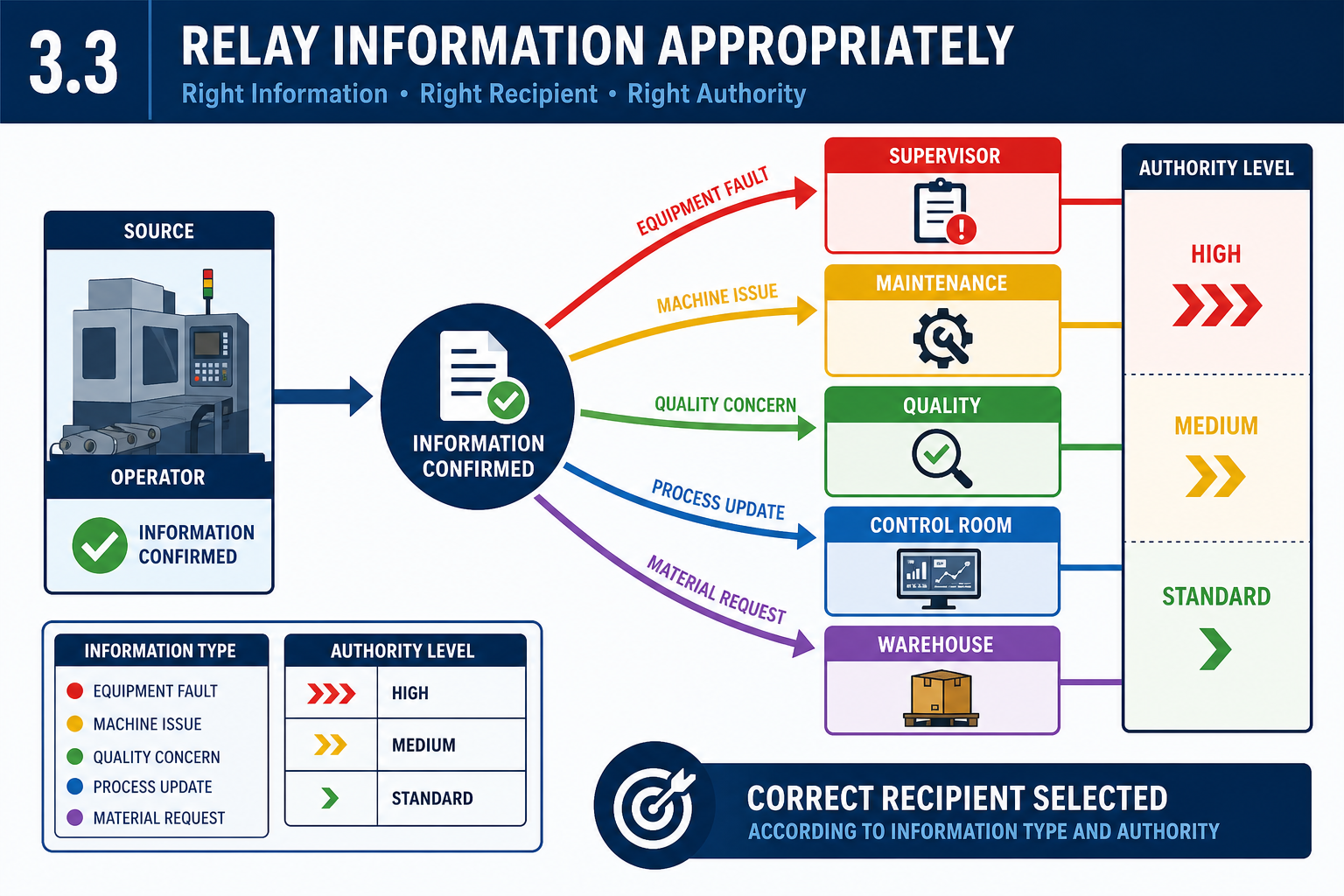
Relaying information to the right place
To relay information means passing it on accurately to the person or section that needs it. The “appropriate person or section” may be your supervisor, control room, maintenance, quality, warehouse, laboratory, safety representative, another operator, or an external driver or contractor, depending on your workplace procedure.
Before sending, check: Who is authorised to receive this? Does the information affect safety, quality, production or security? Does it need to be recorded? If you are unsure, ask your supervisor rather than sending information widely.
Choose a method that suits the receiver
The method must fit the situation. Use face-to-face or radio for immediate operational issues. Use written forms, logbooks, email, maintenance systems or shared inboxes where a record is needed. Use phone contact if the person is away from the area and the matter is time-sensitive. Follow site rules for mobile phones and electronic devices, especially in restricted or hazardous areas.
Match your language to the receiver. A maintenance fitter may need equipment numbers, symptoms and isolation status. A warehouse worker may need pallet ID, product code and bay location. A new operator may need slower explanation and a pointer to the correct SOP. For CALD workers, use plain English, short sentences, standard workplace terms, diagrams or signs where helpful, and confirm understanding respectfully. Avoid idioms such as “she’ll be right” or “knock it over”, which can be confusing.
Make the message usable
Good workplace information is accurate, complete, relevant and timely. State facts, not rumours. Include critical details such as date, time, location, equipment number, batch number, quantity, hazard, action required and your name if needed. If you are relaying a safety issue, be direct: “Stop using Line 3 filler. Guard is damaged. Maintenance has been notified.”
Confirm receipt when the information is important. On radio, use closed-loop communication: “Line 2 is stopped for cleaning.” The receiver replies, “Confirmed, Line 2 stopped for cleaning.” This catches errors caused by noise or poor reception.
Common mistakes and escalation
Do not send confidential records to a group email, leave sensitive documents unattended, or pass on information you have not checked. If the receiver does not understand, try another method or involve a supervisor, interpreter service or bilingual authorised worker if your workplace provides one. If information is urgent and you cannot reach the correct person, follow the escalation path in the procedure, such as contacting the control room or shift manager.