Week 1 — Elements 1–4
2.1 Clarify message if necessary
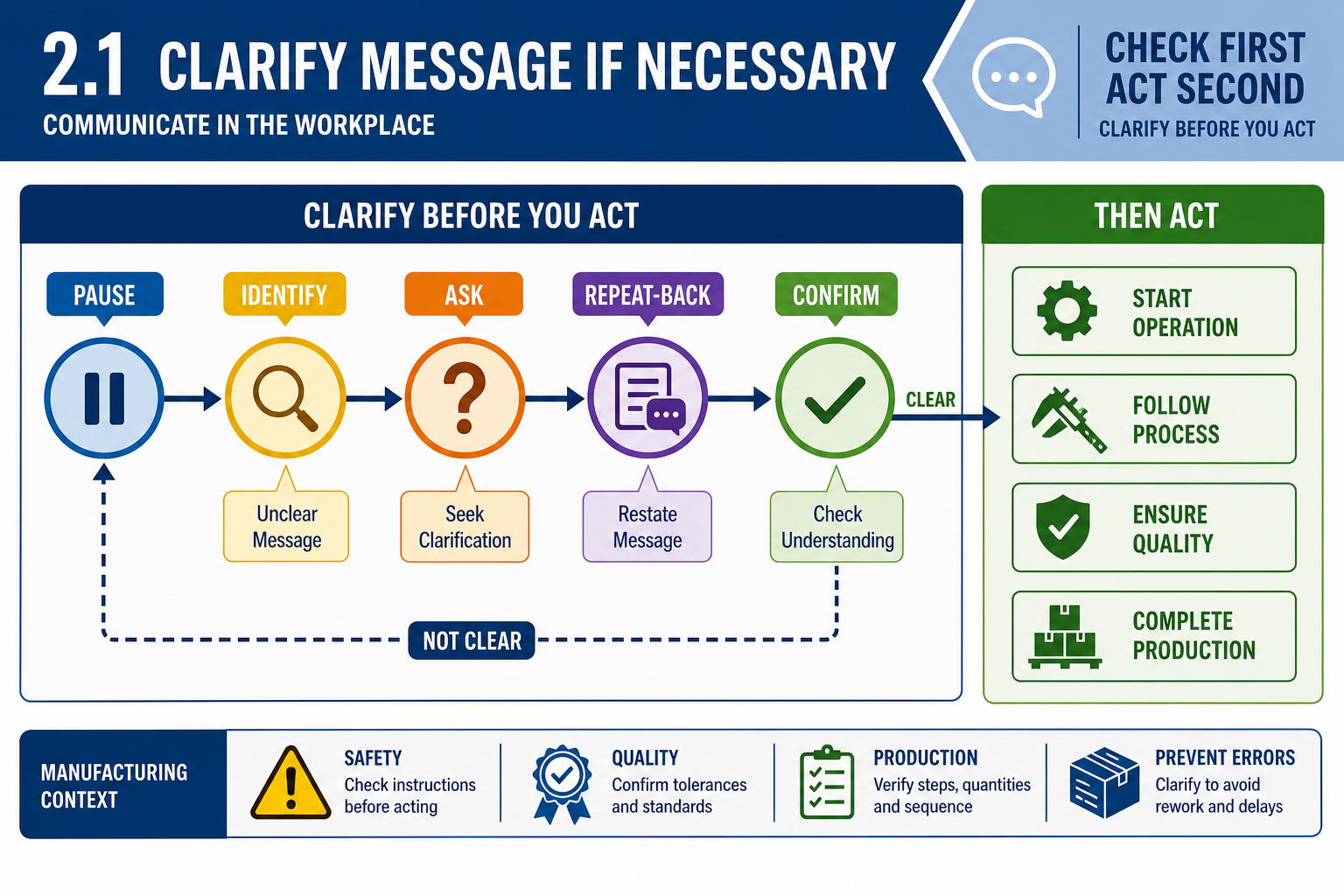
Clarifying the message before you act
To clarify means to check the meaning of a message when it is unclear, incomplete, too fast, noisy, unfamiliar or open to more than one meaning. At AQF 3 level you are expected to use judgement: do not guess when the instruction affects safety, quality, equipment, production or other people.
Use this process:
- Pause and focus. Stop other tasks if safe to do so. Move away from noise if needed, or ask the person to repeat the message on the radio.
- Identify the unclear part. It might be a number, batch code, valve number, location, time, priority, PPE requirement or hazard control.
- Use active listening. Paraphrase what you think was meant: “So you want me to isolate pump P-204 and wait for maintenance, correct?”
- Ask clarifying questions. Use open questions for missing information: “Which line are you referring to?” Use closed questions to confirm: “Do you mean Tank 3, not Tank 13?”
- Check workplace sources. Compare the instruction with the procedure, work order, shift handover, permit, label, sign or screen display.
- Confirm the final meaning. Repeat back the agreed action before starting.
Workplace codes, numbers, symbols, signs and colours are part of the message. In Australian workplaces, safety signage is commonly based on AS/NZS 1319, which uses consistent colours and shapes. Red shows danger, fire equipment or something prohibited. Yellow warns you to be careful. Blue gives mandatory instructions, such as required PPE. Green shows emergency information or safe conditions, such as exits or first aid. Numbers may identify equipment, lines, tanks, batches or chemicals. Never assume that similar numbers mean the same thing.
Example: during shift handover, you hear, “Don’t use the caustic line until QA clears it.” You are unsure whether this means Line C or the chemical transfer line. A safe clarification is: “Just confirming: do you mean the caustic transfer line from the IBC bay, and is it locked out or only on hold?”
Use acceptable language and tone. Clarifying is not arguing. Avoid swearing, sarcasm or blame. Be courteous and respectful of people from different language, cultural or experience backgrounds. If you still cannot understand, escalate to your supervisor rather than guessing.