Week 1 — Elements 1–4
1.3 Relay message accurately to appropriate person or section within designated timelines
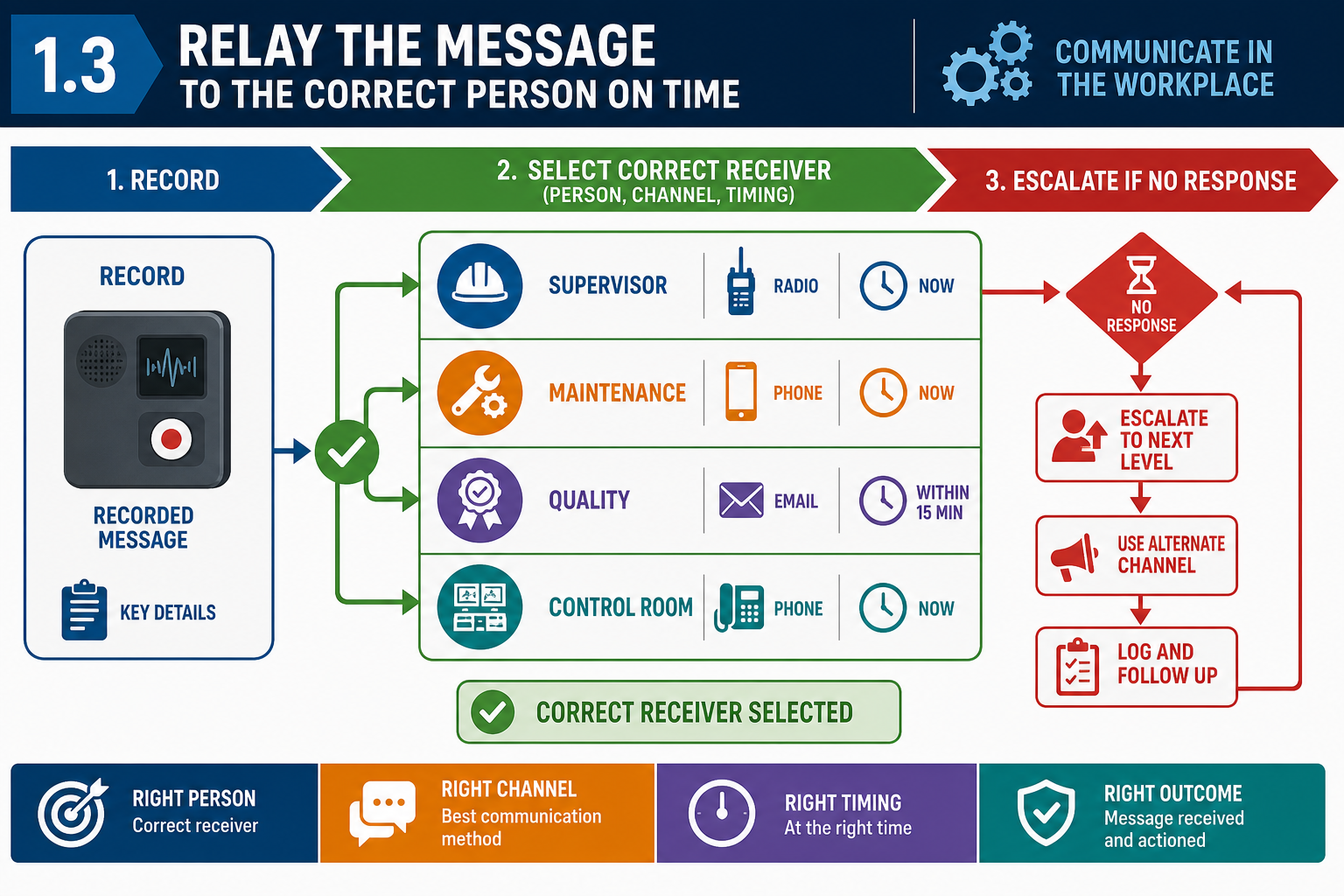
Relay the message accurately
To relay a message is to pass it on without changing the meaning. Accuracy can drop each time a message moves from one person to another, so keep the chain short and use the required channel. Your workplace procedure may state who must receive different types of information: supervisor, control room, maintenance planner, emergency warden, quality officer, warehouse, laboratory, contractor coordinator or another section.
Before relaying, check the record you made. Pass on the facts, not your interpretation. A good relay includes the sender, time, location, key details, required action and urgency. For example: “At 09:40, Sam from packing reported cartons jamming on Line 3 near the outfeed. He has stopped feeding product and requests maintenance attend before restart.”
Choose the right channel and timeline
Designated timelines are the time limits set by workplace procedure, supervisor instruction or the seriousness of the issue. Some messages are routine and can wait for shift handover. Others must be immediate, such as a fire alarm, injury, chemical spill, unsafe equipment, failed isolation, food safety risk or environmental release.
Choose the communication equipment that matches the need:
- Radio for quick operational contact, using call signs and clear phrases
- Phone for direct discussion or when radio is unsuitable
- Email or electronic system for traceable non-urgent details
- Logbook or handover sheet for shift continuity
- Alarm, emergency call point or PA system where emergency procedure requires it
If you cannot contact the intended person, do not let the message stop with you. Follow the escalation path: try the alternate contact, inform the supervisor or control room, use the emergency procedure, or record that contact was attempted. For safety-critical issues, escalation must be immediate.
Check the message was received
Where practical, confirm receipt. This may be a radio acknowledgement, email reply, job number, supervisor sign-off, or a note in the logbook. Closed-loop communication helps prevent “I thought someone else knew” failures.
Common mistakes include sending a message to a friend instead of the responsible role, delaying until break time, summarising so much that key facts are lost, using a public channel for confidential information, or failing to update the record after relaying. A tradesperson-level worker uses judgement: routine information follows normal channels, but anything affecting safety, legal compliance, production continuity or product quality is relayed promptly and escalated if needed.